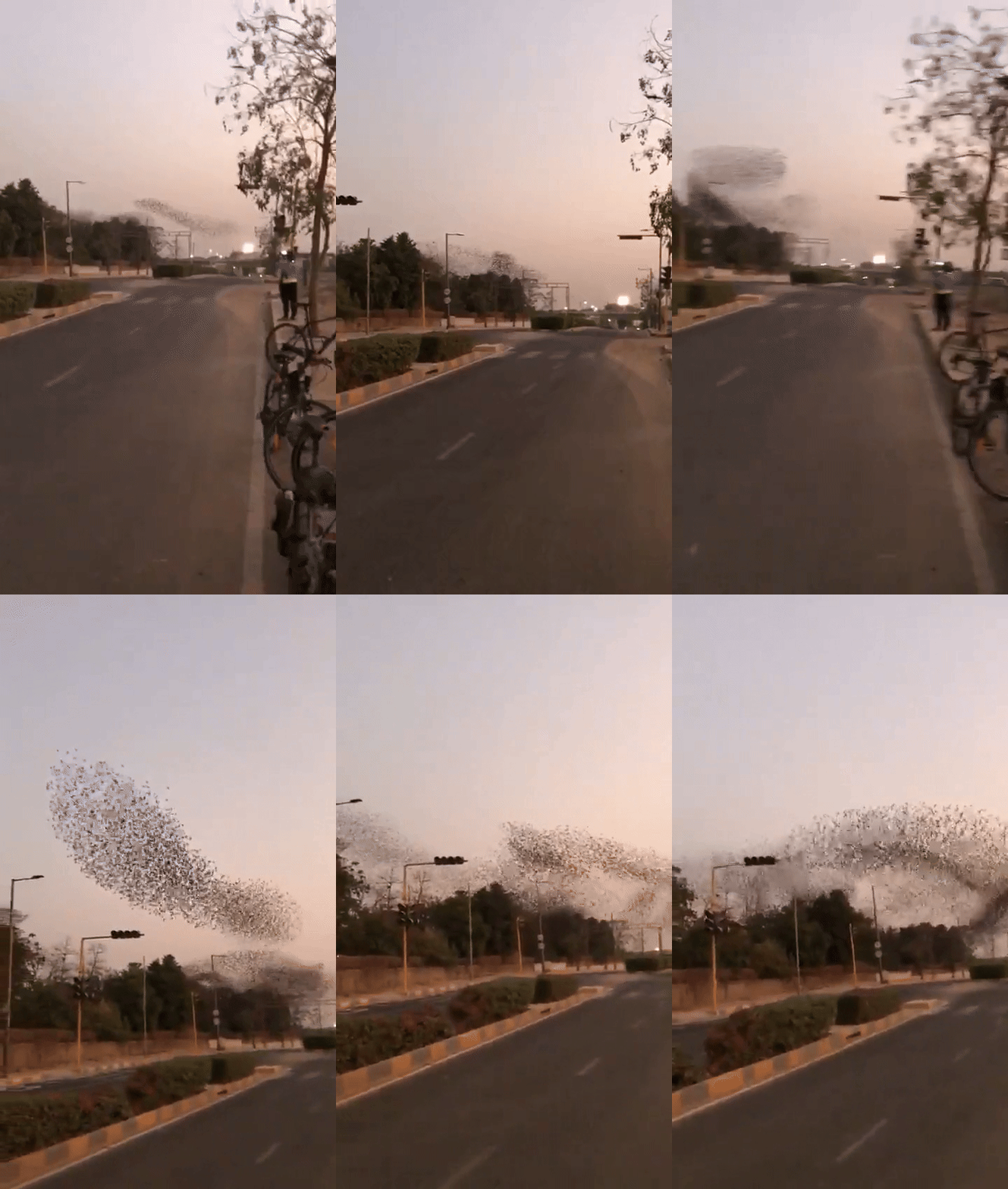
The gif above captures something central to physicist and philosopher David Bohm’s vision of what language and writing could become. Not a mechanical instrument for transmitting information, but a living choreography of self-organizing coherence, like the coordinated flight of a murmuration of starlings. What appears as swirling complexity is not random but the visible expression of a deeper, enfolded order. Meaning is not imposed but unfolds through resonance with an unseen coherence that shapes the field from within. Each word is not a unit of transmission but a dynamic participant, attuning itself to a relational field whose form emerges as it moves. The writing becomes a holding field that does not merely contain but interacts, responding to what arises within it through a logic that is more felt than formulated. Birds do not follow commands, yet their alignment reveals a coherence that exceeds the sum of its parts, suggesting a generative intelligence that moves through them. This is not control, not blueprint, but a relational fidelity to a source that unfolds itself into form through participation.
Bohm’s rheomode was an experimental attempt to reshape grammar so it could reflect his deeper vision of reality, what he called the holomovement, a universe not made of separate things but of continuous unfolding, where everything is in process, interconnected, and always becoming. This view, grounded in quantum mechanics and extending into metaphysics, demands a different kind of language, one that can flow with experience rather than divide it.
Most Western language systems fragment the world. They carve it into subjects and objects, fix actions in time, and freeze relationships into separable terms. This creates a reality of isolation and stasis. Bohm wanted language to move with the grain of reality, to reflect not fixed identities but the way things unfold in relation. Rheomode privileges motion, context, transformation, allowing us to speak not about the world from a distance, but with it as it moves.
This blog takes up that invitation. Not to theorize, but to make contact. Not to explain experience, but to expand the terrain in which experience can arise. Writing here is a way of entering into something larger and alive, a way of allowing perception to stretch into dimensions not usually accessible through declarative speech. The aim is not insight in the usual sense, but the amplification of inner space, a movement toward whatever new lands can only be reached through the right linguistic map.
 unstoryable.com
Leave a comment